Against the backdrop of increasingly stringent environmental protection requirements, Dissolved Oxygen (DO) has become a critical indicator for water quality assessment, from compliant discharge in wastewater treatment plants to refined management in intelligent aquaculture. Traditional manual sampling and laboratory analysis are not only time-consuming and labor-intensive but also fail to capture real-time changes in water quality. Today, the RS485 fluorescent dissolved oxygen sensor—a high-precision device integrating optical technology and digital communication—is redefining the limits of water quality monitoring.
Optical Revolution: Entering the Maintenance-Free Era Without Electrolytes
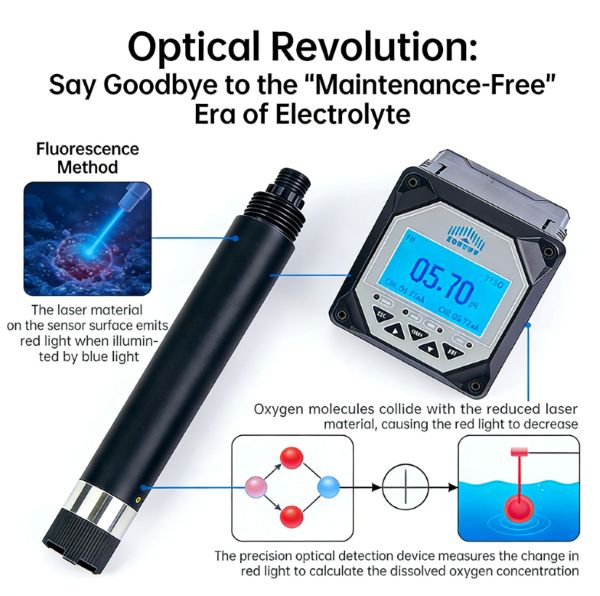
To understand the value of this sensor, we must first examine its core technology: the fluorescence method. Unlike traditional electrochemical electrodes that require oxygen-permeable membranes and electrolytes, it operates based on the physical principle of fluorescence quenching effect: a special fluorescent material coated on the sensor surface emits red light when irradiated by blue light of a specific wavelength. When oxygen molecules exist in water, they collide with the excited fluorescent material, absorb energy, and weaken the red light intensity or shorten its lifetime. The higher the oxygen concentration, the weaker the fluorescence. By measuring this change with a precision optical detection module, the dissolved oxygen concentration can be accurately calculated.
This optical principle delivers revolutionary advantages: no preheating, no electrolytes, and no flow rate requirements. Compared with traditional electrodes that demand frequent membrane replacement and electrolyte replenishment (reducing maintenance costs by approximately 50%), fluorescent sensors are truly low-maintenance and can even operate without calibration during their service life.
Digital Core: Why RS485?
If fluorescence technology is its "heart", the RS485 interface is its "nerve". Widely used in industrial control and environmental monitoring, RS485 is a standard bus communication mode that supports the Modbus-RTU protocol, featuring long transmission distance (up to one kilometer) and strong resistance to common-mode interference.
With RS485 digital signal output, the sensor can connect directly to PLC (Programmable Logic Controller), industrial IoT gateways or DTU (Data Transfer Unit), enabling seamless integration into automated systems. Data is no longer just a fluctuating number on a meter, but a variable that participates in logical control. For example, in an aeration tank, when the sensor feeds back a DO concentration below 2 mg/L via RS485, the control system automatically commands the blower to increase power; when the concentration exceeds the set threshold, the power is automatically reduced to achieve precise aeration, cutting energy consumption by up to 25%.
Application Scenarios: From Deep Water to Farmland
Boasting an IP68 ultra-high protection grade (capable of long-term operation dozens of meters underwater) and a corrosion-resistant titanium alloy or stainless steel housing, this sensor adapts to various harsh environments.
Wastewater Treatment: Real-time DO monitoring in the biochemical treatment stage is key to maintaining activated sludge activity and ensuring effluent COD (Chemical Oxygen Demand) compliance. With intelligent control, the effluent compliance rate can be raised from 80% to over 95%.
Aquaculture: High-value aquatic products such as Penaeus vannamei and grouper are highly sensitive to dissolved oxygen. Through RS485 networking, farmers can monitor DO data of dozens of ponds in real time in the control room. When DO drops too low, aerators start automatically to avoid huge economic losses caused by mass fish death.
Surface Water & Farmland Irrigation: Deploying sensor networks in rivers, lakes and farmland irrigation canals establishes a continuous IoT monitoring system. For instance, analyzing diurnal DO variation patterns helps optimize the operation of farm aeration equipment, reducing energy consumption by about 30%.

The global popularization of RS485 fluorescent dissolved oxygen sensors represents not only the iteration of monitoring technology but also the international convergence of water quality monitoring standards. Compliant with ISO, ASTM and other international standards and adopting the universal Modbus protocol, it converts water quality data into globally understandable, comparable and interoperable information. From fjords in Northern Europe to fish ponds in Southeast Asia, from wastewater treatment plants in Europe to surface water monitoring stations in the Americas, these "intelligent eyes" submerged underwater are building a technological defense line for the sustainable management of global water resources.https://www.zonewuiot.com/water-quality-sensors_c1


